The tank gets all the attention, but the tank is the simple part. The absorption area is where systems actually die, and it is the expensive half to put right.
What the drain field does
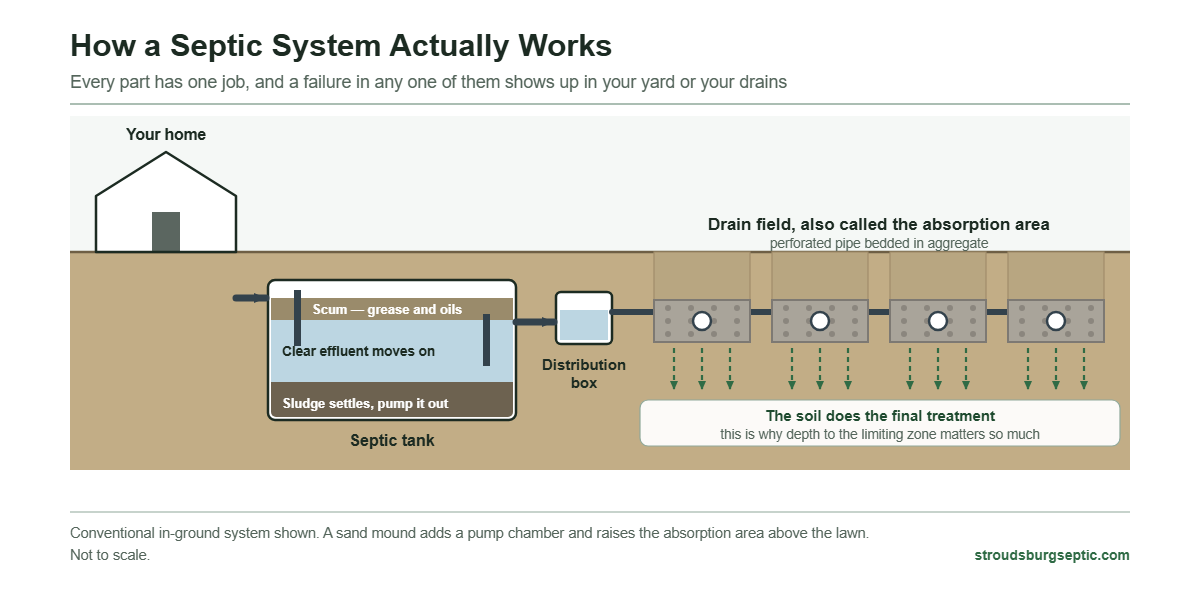
The tank separates solids and holds them. Everything else, the liquid effluent, flows out to the absorption area, which may be an in-ground bed, a trench system, or an elevated mound.
There the effluent passes into the soil, and the soil does the real treatment. Bacteria in the upper soil layers break down what is left before the water reaches groundwater. The field is not a drain in the plumbing sense. It is a biological filter, and it depends on the soil around it staying able to accept water.
Why fields fail
The main mechanism is the biomat. A biological layer forms at the boundary between the gravel and the soil. A thin one is normal and even useful, because it slows flow and improves treatment.
The problem is when it thickens until water stops passing through. At that point effluent has nowhere to go. It backs up toward the house, or surfaces in the yard, or both.
What accelerates it:
- Never pumping the tank, so solids carry over into the field. This is the biggest single cause and the most preventable.
- Hydraulic overload, meaning more water than the field was sized for. Long showers, laundry all in one day, a leaking toilet running unnoticed for weeks.
- Clean water going where it should not. Roof downspouts, sump pumps, and driveway runoff directed toward the absorption area.
- Compaction from vehicles, trailers, or equipment parked over the field.
- Tree and shrub roots finding the lines.
- Grease and non-degradable items, including wipes labelled flushable.
- Age. Fields do not last forever even when treated well.
Can a failed field be saved
Sometimes the field is not the problem at all, and that is worth ruling out first. A crushed line, a clogged effluent filter, a tipped or failed distribution box sending everything to one lateral, roots in a single line, a dead pump. These are real and fixable.
If the biomat has genuinely sealed the soil interface, the honest answer is that it does not reliably come back. Products sold to rejuvenate a failed field have a poor record. So does simply resting it, though resting a field does sometimes buy time on a system that is stressed rather than finished.
We would rather find the cheap fix if there is one. The diagnosis is what tells you.
What replacement involves
A new absorption area is designed to current standards, which is the point most people trip over. The original field was permitted under whatever rules applied then. The replacement is permitted under today’s.
On many Monroe County lots that means the replacement cannot be an in-ground bed even though the original was, because the soil will not support one under current separation requirements. An elevated mound or an advanced treatment unit becomes the permitted option.
The new field also has to go somewhere that satisfies setbacks from the well, property lines, structures, and any surface water. That is not always where the old one was, and on a constrained lot finding the space is the hardest part of the job.
The old field is normally abandoned in place rather than excavated.
Protecting a new field
Once it is in, the difference between fifteen years and thirty is mostly behaviour.
- Pump the tank on a regular schedule. This is the single highest-value thing you can do.
- Fix running toilets and dripping fixtures promptly. A silent leak can add hundreds of gallons a day.
- Spread laundry across the week rather than doing it all on Saturday.
- Keep roof and surface drainage directed well away from the absorption area.
- Nothing heavier than a mower on it, ever.
- Grass over it. No trees, no shrubs, no vegetable beds, no patio.
- Nothing down the drain that is not waste or toilet paper, regardless of what the packaging claims.
Get it diagnosed properly
Repair, replacement, or something simpler. Tell us what you are seeing and we will start there.