Advanced treatment is the answer when the site will not take anything else. It is also the option with the longest tail of ongoing cost, and the one homeowners are least often told the full story about before they sign.
What it does
A conventional septic tank works anaerobically. Bacteria break waste down in the absence of oxygen, slowly and partially, and the soil does the rest of the work.
An aerobic treatment unit introduces oxygen, usually with a blower. Aerobic bacteria are far more efficient, so the effluent leaving the unit is substantially cleaner than what leaves a conventional tank.
That is the whole point. Because the water reaching the ground is already well treated, the state can approve a much smaller absorption area than raw septic effluent would require. On a lot where a full-size mound simply will not fit, that difference is what makes the property usable.
When one gets specified
- Small lots where a conventional bed or a full mound cannot fit within required setbacks
- Properties close to a well, stream, pond, or wetland, where treatment quality matters more
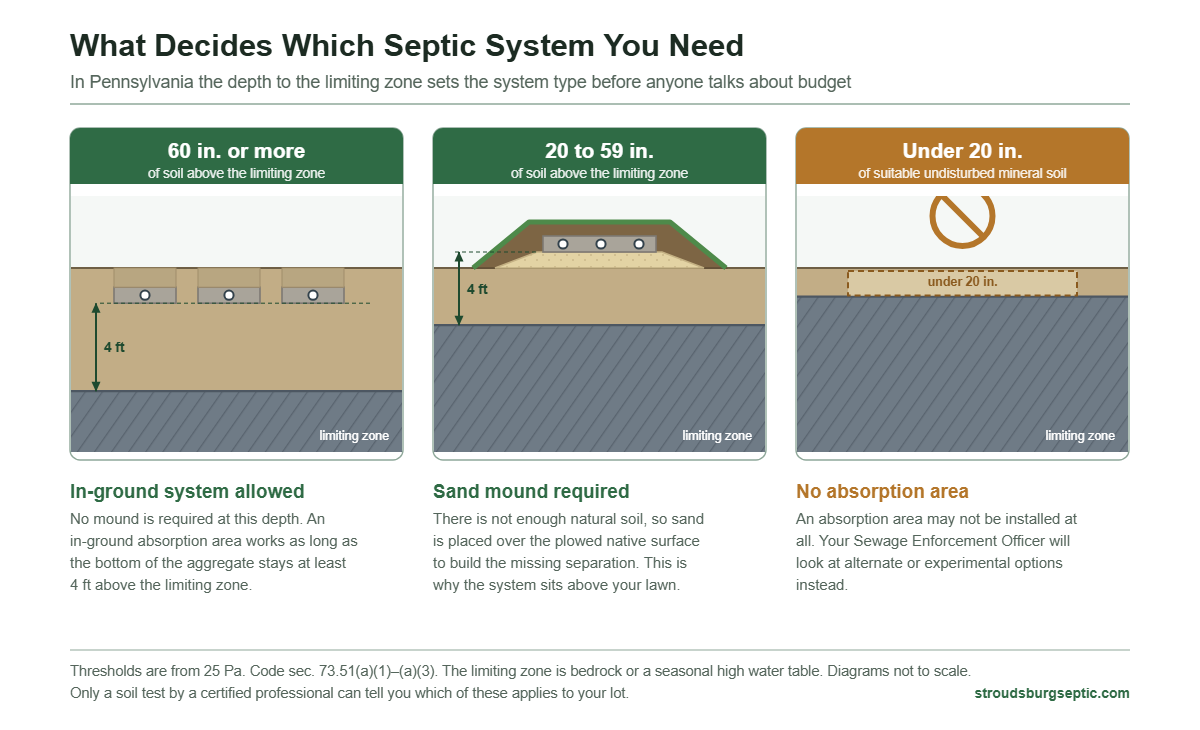
- Very shallow depth to bedrock or a high seasonal water table
- Replacing a failed system on a parcel subdivided under older, looser rules
- Repairs where the remaining usable area is smaller than a new install would need
Pennsylvania maintains a list of approved alternate and experimental technologies. What you can install is what is on that list and what your township will permit, which is worth confirming rather than assuming.
The ongoing commitment
This is the part to understand before you commit, because it is permanent.
It needs electricity. A blower runs continuously or on a cycle. That is a real line on your power bill, modest but perpetual, and a prolonged outage affects treatment.
It needs scheduled servicing. These are mechanical systems with components that wear. Requirements are set locally rather than by a single statewide rule. Many Pennsylvania townships require an annual service agreement with a certified technician, and some issue an operating permit for alternative systems that depends on keeping it current. Ask your township what applies at your address before you commit, because letting it lapse can put the permit at risk.
It has parts that fail. Blowers, pumps, floats, control panels, alarms. Budget for occasional replacement across the life of the system.
Add the annual service cost and the power to the install price before you compare it against a mound. Over twenty years the gap narrows considerably, and sometimes reverses.
Advanced treatment against a sand mound
Choose a mound where you have the room. It is largely passive, has no moving parts in the bed itself, and asks very little of you beyond keeping weight off it and pumping the tank.
Choose advanced treatment where you do not. Small lot, tight setbacks, proximity to water, or a site where the mound footprint would consume the usable yard.
Frequently the two are combined, with an advanced unit feeding a reduced-size absorption area. More on sand mounds.
Questions worth asking any installer
- Which specific approved technology are you proposing, and why that one for this site
- What does the required maintenance contract cost per year, and who provides it
- What is the expected power draw
- What happens if the power goes out for several days
- Which components are likely to need replacing, and roughly when
- What does the alarm look and sound like, and what should I do when it goes off
An installer who cannot answer the maintenance and running-cost questions clearly is selling you the box rather than the system.
Find out whether your lot actually needs one
We will tell you plainly. They are the right answer often here, but not always, and they are not the cheap answer.