If you have been told your property needs a sand mound, you have probably also been told what it costs, and the two pieces of information together tend to land badly.
Here is what a mound actually is, why so much of Monroe County ends up with one, and what owning one is like.
What a sand mound is
A conventional septic system lets treated effluent soak downward into the native soil. That only works if there is enough suitable soil beneath the bed to do the filtering before the water reaches bedrock or groundwater.
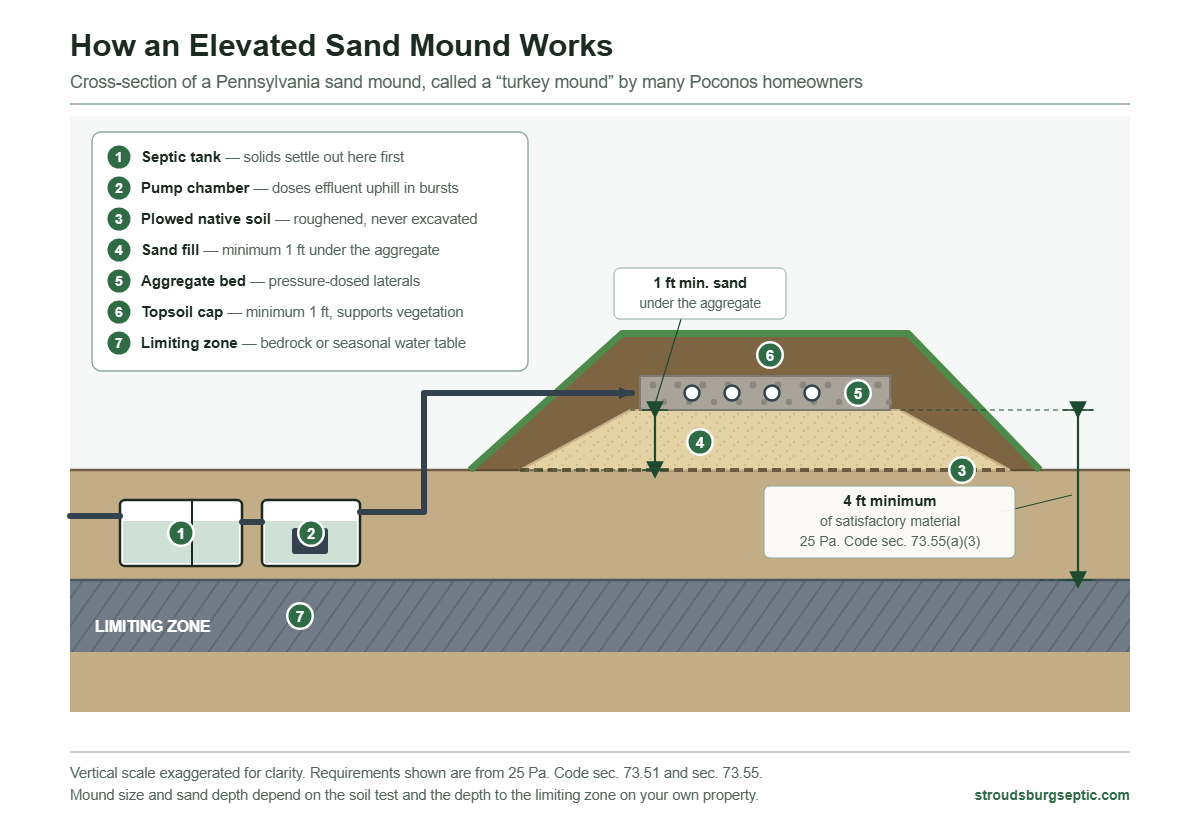
When there is not, the answer is to stop relying on the ground and build the filtering medium yourself, above grade. That is a sand mound. Imported sand is placed on the prepared natural surface, a gravel distribution bed sits within it, and the whole thing is capped with topsoil and seeded.
Effluent is pumped up into the mound in timed doses rather than trickling in continuously. Dosing matters, because it spreads the load evenly across the bed instead of overwhelming one corner of it.
Why the Poconos, specifically
Two features of the local ground drive this.
Shallow depth to bedrock. Much of the county sits on glacial deposits over rock that is not far down. Code requires a vertical separation between the bottom of the absorption area and any limiting zone. Where the rock is shallow, an in-ground bed cannot achieve that separation, but a mound built upward can.
Slow-draining soils and seasonal water tables. Glacial till compacts densely and moves water slowly. A high seasonal water table has the same effect as shallow rock, because it is a limiting zone whether or not it is there year round. A perc test run in a dry August can read very differently from the same site in April, which is why the soil profile matters as much as the perc rate.
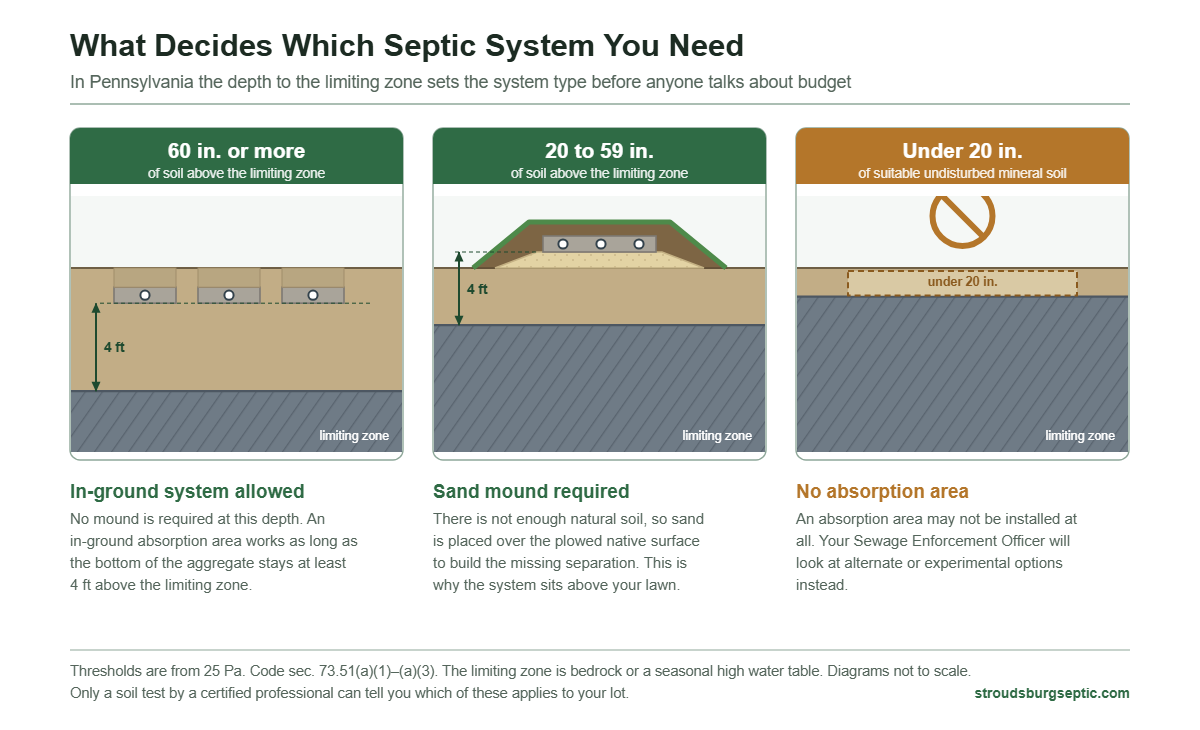
The rule that drives it is a separation requirement. Pennsylvania’s on-lot regulations, at 25 Pa. Code Chapter 73, require four feet of satisfactory material between the bottom of the aggregate and the top of the limiting zone. The limiting zone is whichever comes first, bedrock or the seasonal high water table.
Where the limiting zone is sixty inches or deeper, that separation can be achieved with an in-ground bed. Where it is shallower than sixty inches, code requires an elevated sand mound instead, and the imported sand makes up the difference. Below twenty inches of suitable undisturbed mineral soil, no absorption area is permitted at all. At least a foot of sand sits under the aggregate in every elevated mound, and the sand itself has to meet a specified gradation rather than being whatever is cheapest to truck in.
Slope matters too. There is a maximum grade beyond which a mound bed will not be permitted, which is why some steep Pocono lots end up on a different system entirely.
The practical result is that across large parts of Monroe County the mound is the standard outcome rather than the exception. If you have been quoted one, you are not being singled out.
What it looks like in your yard
This is the part people are least prepared for. A mound is a visible raised area, typically a low elongated hill covered in grass. Size depends on the design, which depends on bedroom count and the perc rate, so there is no single answer, but it takes up meaningfully more space than an in-ground bed and it is not invisible.
It can be landscaped to blend in, within limits. What you cannot do is plant trees or deep-rooted shrubs on it, build on it, or run anything heavy across it.
Living with a mound
- Keep vehicles, trailers, and heavy equipment off it. Compaction ruins the sand structure and there is no repair for that.
- Mow it, but do not till it or add fill on top.
- Grass only. Roots from trees and shrubs will find the bed.
- Keep roof runoff, downspouts, and driveway drainage directed away from it. Adding clean rainwater to an absorption area is a slow way to overload it.
- Pump the tank on schedule. Solids reaching the pump chamber and then the mound is the fastest way to kill one.
- If there is a pump, it has moving parts and a control panel. Know where the alarm is and what it sounds like.
Common misconceptions
“A mound means the installer is padding the job.” The design is dictated by the soil test and approved by the township sewage enforcement officer. The installer does not get to choose.
“I can put a smaller one in.” Sizing follows the design standard for your bedroom count and perc rate. A mound built undersized fails, usually within a few years, and then you pay twice.
“Mounds do not last.” A properly built and properly treated mound has a reasonable service life. The ones that fail early are almost always the ones that got compacted, overloaded, or never had the tank pumped.
Mound or advanced treatment
Where a mound will not physically fit, or the lot is small, or you are close to a well or a stream, an advanced treatment unit is often the alternative. It treats effluent far more thoroughly, which lets the state approve a much smaller absorption area.
The trade-off is ongoing. An advanced unit needs power and a maintenance contract for the life of the system, where a mound is largely passive. More on advanced treatment systems.
Not sure which one your lot needs?
The soil test answers it. Tell us the address and we will start there.